Halloween candy. Holiday baking. THC products. Human medications. Vitamins and supplements. Houseguests who leave bags on the floor.
For veterinary teams, the holidays bring a familiar increase in opportunities for accidental toxin ingestion. Chocolate remains one of the most common pet exposures reported to poison-control centers, while human medications, foods, and supplements routinely rank among the leading causes of pet poisoning.
The cases are familiar. The charcoal treatment is familiar too.
And for decades, so have been the frustrations that come with it.
Large bottles of black liquid. Difficult administration. Incomplete dosing. Messy patients. Messy treatment areas. And, occasionally, a veterinary technician wondering whether those holiday scrubs will ever be the same again.
Activated charcoal remains an important tool in veterinary gastrointestinal decontamination. But the way we deliver it can be better.
That is where ReadyRESCUE™ comes in.
Same purpose. A very different charcoal experience.
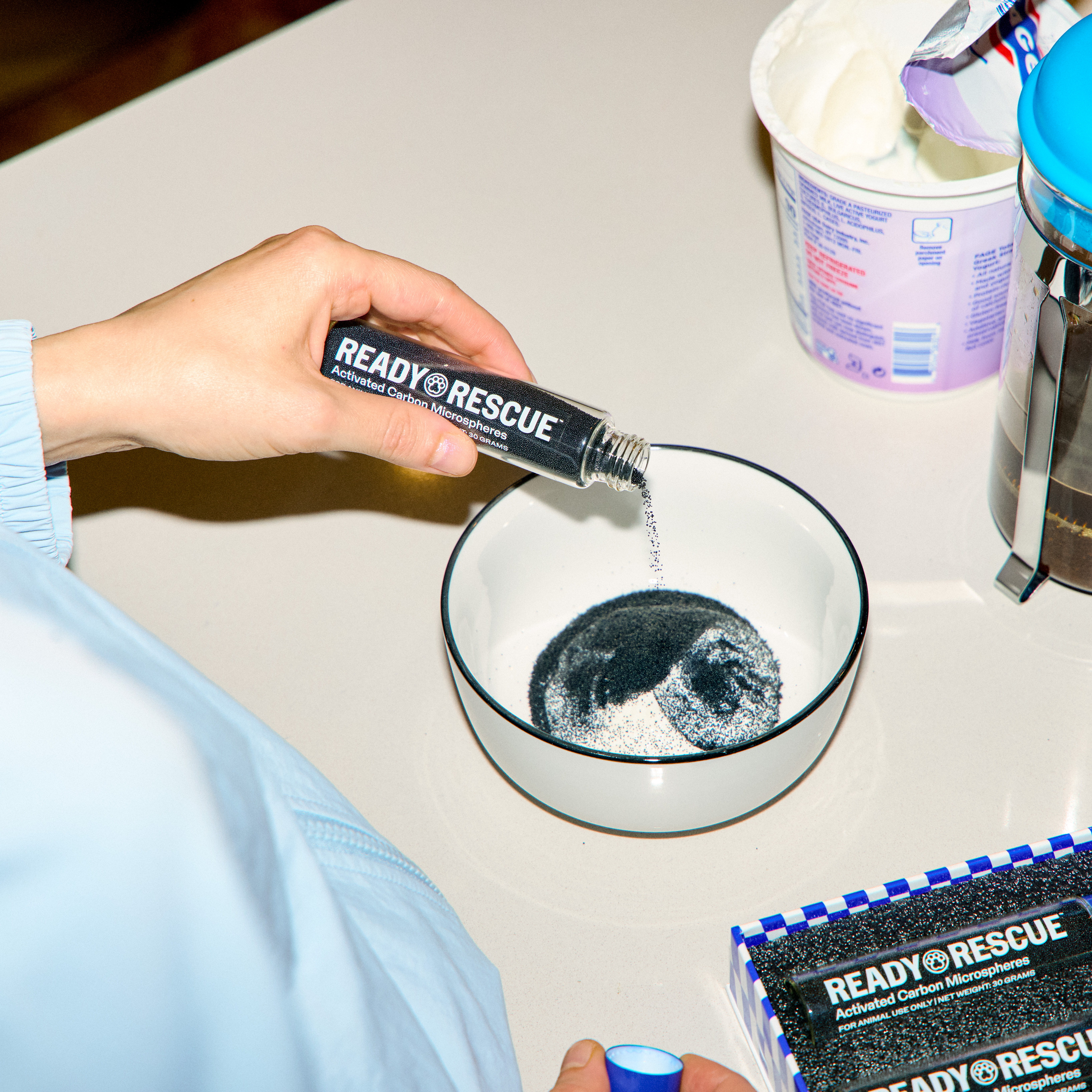
ReadyRESCUE uses highly porous activated carbon spheres to deliver a clinically meaningful mass of activated carbon in a dramatically smaller volume than conventional liquid charcoal.
Gram for gram, independent research performed at the University of Georgia and published in Frontiers in Veterinary Science found ReadyRESCUE, Toxiban, and laboratory-grade powdered activated charcoal effectively reduced concentrations of the majority of common veterinary toxicants evaluated in vitro.
The difference veterinarians notice is practical.
ReadyRESCUE is approximately one-seventh the volume of Toxiban liquid - and it’s clean.
That means less material to administer, less mess, and a much more manageable way to deliver an appropriate charcoal dose.
In fact, a veterinary hospital white paper shows that a 4.5 g/kg dose of ReadyRESCUE can be delivered in 40% the time of a 1.9 g/kg dose of Toxiban- **more than twice the charcoal dose given in less than half the time- and with no mess. **
For the veterinary team working through a busy holiday ER shift, that matters.
Toxiban versus ReadyRESCUE: volume matters
Traditional liquid charcoal works, but delivering enough charcoal can require a substantial volume.
That can make administration difficult, particularly in patients that resist oral dosing. It can also mean spending valuable staff time administering charcoal, cleaning the patient, cleaning the treatment area, and dealing with the inevitable black splatter.
ReadyRESCUE was designed specifically to solve those practical limitations.
The activated carbon spheres are compact, tasteless, and can be mixed into a small amount of palatable food or appropriately prepared for enteral administration. It can also be syringed to patient with significantly less volume or administered via a large nasogastric tube.
Rather than thinking primarily about how much liquid charcoal a patient will tolerate, the clinician can think about what really matters:
How many grams of activated charcoal do I want this patient to receive?
That distinction becomes particularly important when a larger charcoal dose is desirable.
And then there is sorbitol.
Many veterinarians were trained to associate activated charcoal with sorbitol.
But it is worth asking what the sorbitol is actually accomplishing.
Sorbitol is not the adsorbent. Activated charcoal is.
Sorbitol is an osmotic cathartic intended to accelerate gastrointestinal transit. Yet evidence supporting routine cathartic use in dogs and cats is absent, despite two peer-reviewed publications (in fact one publication showed that sorbitol hindered charcoals efficacy.) A human toxicology position statement concluded that experimental evidence regarding cathartics is conflicting and that no clinical studies had demonstrated that cathartics improve outcomes in poisoned patients; routine cathartic use with activated charcoal was therefore not endorsed.
There are some human experimental studies suggesting that catharsis can reduce absorption under certain circumstances—but the magnitude of that effect provides useful perspective.
In one human volunteer aspirin model, adding sorbitol to activated charcoal reduced salicylate absorption by an additional 28% compared with charcoal alone. In another volunteer study involving acetaminophen, adding sorbitol did not improve the efficacy of charcoal and instead increased adverse effects.
Animal experimental data tell a similar story. In a canine acetaminophen model, cathartics alone reduced systemic exposure by approximately 15–30%, while charcoal alone reduced exposure by about 93%; adding cathartics did not improve the charcoal effect in that model.
That raises an interesting clinical question.
If you want more adsorption, why not give more adsorbent?
Historically, simply increasing the charcoal dose was not especially practical.
Doubling the dose of conventional liquid charcoal might mean doubling an already large volume of black slurry. In a 25- or 30-kg dog, that can quickly become logistically difficult and clinically dangerous due to aspiration risks.
ReadyRESCUE changes that equation.
Because it is approximately one-seventh the volume of conventional Toxiban liquid for an equivalent mass of charcoal, clinicians can consider administering a larger mass of activated charcoal without proportionally creating an enormous treatment volume.
If the goal is to increase the amount of toxin available for adsorption, increasing the dose of the actual adsorbent is a straightforward strategy.
And because ReadyRESCUE contains no sorbitol or other cathartic, increasing the charcoal dose does not automatically mean increasing the cathartic dose along with it.
More charcoal without automatically giving more cathartic
This is particularly relevant because sorbitol is not physiologically inert.
A prospective study in healthy dogs receiving a single dose of activated charcoal with sorbitol demonstrated significant changes consistent with dehydration, including increased serum sodium, weight loss, and increased hematocrit compared with the control period. The authors recommended electrolyte monitoring and fluid therapy in patients receiving charcoal with sorbitol.
The practical advantage of ReadyRESCUE is therefore flexibility.
The clinician can choose the activated-charcoal dose independently without automatically increasing exposure to an osmotic cathartic.
That becomes especially useful when high-dose or multidose charcoal is being considered.
And sometimes the patient may not need to stay in the hospital just for the charcoal
There is another important advantage of ReadyRESCUE during the holiday season: continuation of charcoal therapy outside the hospital in appropriately selected patients.
Some toxicities require repeated doses of activated charcoal because the toxin undergoes enterohepatic recirculation. With traditional charcoal products, this can contribute to hospitalization simply because administering repeated doses of traditional charcoals at home is impractical.
ReadyRESCUE can change that conversation.
For a clinically appropriate, stable patient whose veterinarian determines that ongoing charcoal administration is indicated and safe at home, ReadyRESCUE allows the hospital to administer the initial decontamination treatment and dispense subsequent veterinarian-directed doses to the owner for home use.
That can mean:
Less hospitalization. Less technician time. Lower cost for the client. More kennel availability during a busy holiday shift.
And perhaps most importantly, veterinary staff can spend their time treating the patients that actually need hospitalization rather than repeatedly administering large volumes of charcoal to a stable patient (and doing laundry when they get home.)
The ability to send veterinarian-directed, practical, charcoal treatment home represents a meaningful change in how a toxicity case can be managed.
Your activated charcoal should make toxicity treatment easier—not harder
The holidays are busy enough.
Veterinary teams should not have to choose between delivering an appropriate activated-charcoal dose and managing the logistical consequences of administering a huge volume of black liquid.
ReadyRESCUE provides:
-
**1/7 the volume of Toxiban liquid **
-
Peer-reviewed adsorption data across common veterinary toxicants
-
No sorbitol or other cathartics
-
The flexibility to administer higher charcoal doses without automatically increasing cathartic exposure
-
A cleaner, easier administration experience
-
The potential for veterinarian-directed at-home continuation in appropriate patients
Activated charcoal has been part of veterinary toxicology for decades.
ReadyRESCUE simply makes the charcoal easier to use.
And when the waiting room is full, the chocolate toxicity just walked through the door, and your technician is wearing their favorite holiday scrubs, that is not a small improvement.
Share
Related blogs
Now Available: 16 New Cat Medications, Treatments and Wellness Products
What is in store for microchip technology?