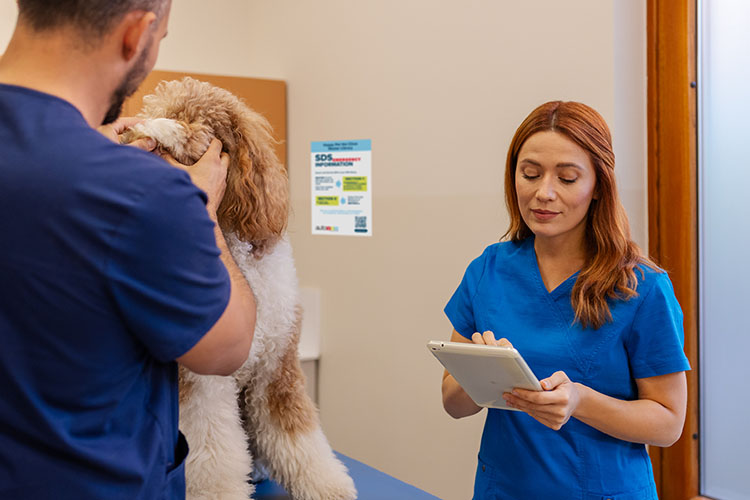
On a scale of one to 10, how comfortable are you using a safety data sheet (SDS)?
If your answer is anywhere between “middling” and “not very,” you’re not alone. In a recent Patterson webinar, 74% of respondents said the same.
The reality is that busy veterinary teams don’t always have the time to study and master regulatory details. And let’s be honest, most people aren’t casually reading OSHA’s Standard 29 CFR 1910.1030 in their spare time.
Still, compliance matters even if obscure regulatory codes aren’t always clear-cut. We’re here to ease that journey by summarizing substantial changes that deserve immediate attention.
OSHA rules have changed
In 2024, OSHA revised its Hazard Communication (HazCom) Standard to better align with international standards and improve workers’ protection.
These updates focus heavily on SDSs and labeling, with the goal of making hazard information clearer and more accessible to employees. Changes include new hazard categories, updated classifications, revised labeling requirements (especially small containers), and additional pictograms and signal words.
These updates apply directly to common veterinary products like disinfectants, anesthetics and medications. This means that veterinary suppliers need to modify their SDSs and labels to meet the new standards.
While manufacturers and suppliers are responsible for changes to source documents, adherence ultimately extends to veterinary practices. OSHA recently extended the compliance deadline for the latter group, with enforcement now set for November 20, 2026.
What this means for your practice
To meet the updated HazCom requirements, clinics should start taking action now. By the enforcement deadline, your practice should:
-
Audit and secure new SDSs for all chemical substances.
-
Ensure proper labeling on secondary containers.
-
Identify and respond to any product reclassifications.
-
Train your staff on updated HazCom requirements.
-
Document all training within your written HazCom program.
Many suppliers have already begun distributing updated SDSs. However, it’s important to verify that what you have is current.
A quick way to check:
-
Section 9 (Physical and chemical properties) should reflect a new structure, beginning with “Physical state” instead of “Appearance” followed by “Color.”
-
Section 11 (Toxicological information) should include more detailed information about interactive data.
If both sections reflect these updates, the SDS is likely compliant.
Why starting early matters
Even with updated materials becoming available, compliance takes time. It’s the responsibility of the employer to meet OSHA safety requirements, so clinics may have to pursue these materials themselves. Staff need to be familiarized with the new format and emergency procedures may also need to be revised.
Starting early gives your team time to adapt without disrupting daily operations.
Be proactive, own your compliance
OSHA requires practices to maintain detailed safety information for all hazardous veterinary substances and mixtures. That means having the latest SDS on file for every applicable product, even those that haven’tbeen reclassified.
Manufacturers and distributors must complete SDS and label updates by May 19, 2026, so clinics should expect to see new materials from suppliers around that time.
If you receive a product after that date and its SDS doesn’t reflect the new format, follow up with the vendor and request an updated version. Be sure to document this communication. It shows due diligence if your practice is visited by an OSHA inspector.
It’s equally important to review updated SDSs carefully. Pay close attention to:
-
Storage and handling requirements (Section 7).
-
Hazard classifications.
-
Emergency procedures.
Training your team to understand these updates is critical. Employees should know how to:
-
Locate key information by SDS sections.
-
Interpret hazard symbols and labels.
-
Follow updated handling and safety procedures.
And remember – training must be documented. This is a required part of your written Hazard Communication program, which serves as a record of your compliance efforts.
Choose accelerators, not shortcuts
Compliance isn’t a place to cut corners. Failing to meet OSHA standards can lead to fines, operational disruptions, legal risks and even employee turnover.
At the same time, managing compliance manually can be overwhelming. The average veterinary practice handles over 450 products requiring SDSs, making it a time-intensive task to track and update documentation. That’s where digital tools can make a meaningful difference.
Solutions like AutoSDS provide a centralized, online repository for SDSs. The platform monitors orders placed with Patterson Veterinary and automatically loads the SDS for purchased products. It sources the most up-to-date version of an SDS, so when a manufacturer publishes changes, it’s reflected in the electronic library.
This saves time and improves accuracy and recordkeeping. It also aligns with OSHA’s increasing preference for digital systems, which offer better accessibility and long-term storage capabilities.
While printed SDS binders are still acceptable, digital systems simplify compliance, especially when practices are required to maintain exposure records for up to 30 years.
Final pulse check
The complex body of codes that act as rules and guidelines aren’t necessarily tailored for the layman, but they are written for the good of every veterinary professional.
The updated OSHA Hazard Communication Standard is designed to improve safety for veterinary teams handling potentially hazardous materials. Adopting these changes isn’t just about compliance; it’s about creating a safer workplace.
If you have questions about the requirement changes or want support navigating them by the November 20 deadline, we have resources to help.
Patterson is more than just a distributor – we are a compliance partner. We provide solutions specially developed to make OSHA compliance simple, straightforward and low stress.
Training checklist
Team training on the 2024 HazCom Standard is mandatory. Be sure to:
-
Review major updates, including hazard classifications and SDS format changes.
-
Train staff on key SDS sections (especially Sections 2, 9, 11 and 14).
-
Educate teams on updated labeling requirements.
-
Review changes to handling and storage procedures.
-
Update emergency response protocols as needed.
Listen to regulatory experts discuss the new OSHA rules in greater detail with tips on how best to manage the change. Go to here to watch our webinar.
Share
Related blogs

Why Regulators Are Cracking Down on Dosimetry Violations

OSHA Requirements for Small and Companion Animal Facilities